
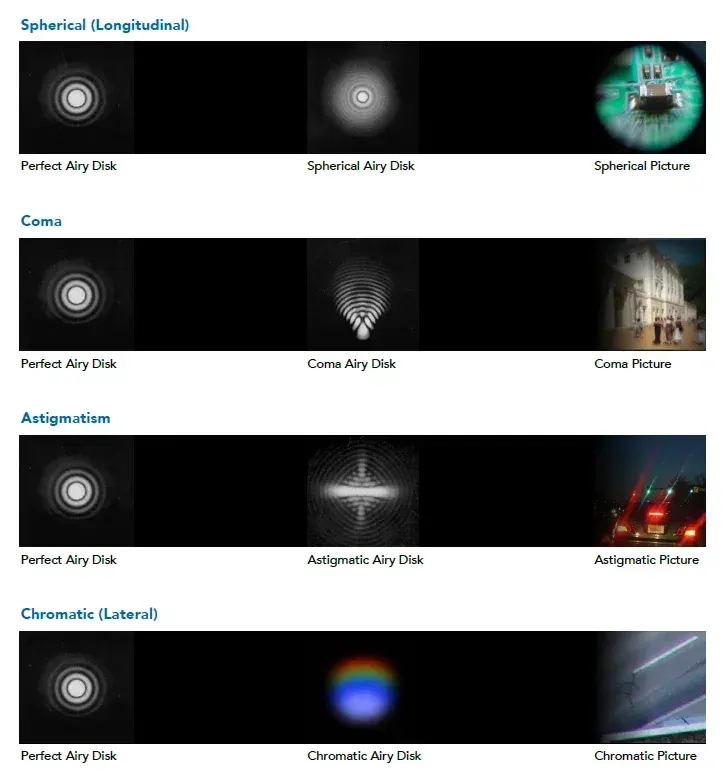
Lens aberrations are optical errors that stop light from different parts of a lens from meeting at a single point. The main monochromatic types are spherical aberration, coma and astigmatism. They soften detail and distort point lights, and they are usually worst at wide apertures and toward the corners of the frame.
Why It Matters
Every lens is a compromise. Real glass cannot bend all light perfectly, so lens designers use many elements, special shapes and coatings to cancel errors against one another.
Knowing what each aberration looks like tells you why a lens is soft wide open, why stars turn into little wings at the edges, and which fixes work: stopping down, choosing a better lens or correcting in software.
Beginner Lens Aberrations For Beginners
An ideal lens would focus every ray from a point in the scene onto one point on the sensor. In practice rays that pass through the edge of the lens focus at a slightly different place from rays through the center, and rays from off-axis points arrive at an angle. Those misses create the flaws below.
The Three You Will See Most
| Aberration | What It Looks Like | Where You See It |
|---|---|---|
| Spherical aberration | A soft, glowing haze over sharp detail | Wide open, across the whole frame |
| Coma | Point lights stretched into comet or wing shapes | Frame corners, wide open, at night |
| Astigmatism | Lines at different angles focus at different distances | Edges and corners, even slightly stopped down |
Spotting Them In Your Pictures
Spherical aberration is easiest to see on a portrait shot wide open, where eyes look slightly dreamy rather than crisp. Coma shows up in astrophotography as stars near the corners that look like little seagulls. Astigmatism makes corner detail smear in a direction that points toward or around the center of the frame.
Simple Ways To Reduce Them
- Stop down by one or two stops. This blocks the outer rays that cause most of the error.
- Keep important detail away from the extreme corners at wide apertures.
- Use a lens with aspherical elements, which are shaped to cancel errors. See aspherical lens elements.
- Check sample images and charts before buying, since the same focal length from two makers can differ a lot.
Common Mistakes
- Blaming the camera for softness that is simply the lens wide open.
- Stopping down too far, where diffraction softens the image instead. The lesson on lens diffraction limit shows where that begins.
- Confusing aberrations with focus errors. Test focus accuracy first so you know which problem you have.
- Expecting software to fix everything. Sharpening can raise contrast but cannot restore detail that never focused.
A Quick Note On Color Fringing
Chromatic aberration is a related problem where colors focus at different positions, giving colored edges. It is covered in its own lesson, chromatic aberration. The three flaws above exist even in a pure black and white image.
When Softness Is Acceptable
A little softness wide open is not a defect. A portrait at f/1.4 often benefits from the gentle glow, because it flatters skin and hides small blemishes. The same lens at f/5.6 becomes crisp. Choose the aperture for the picture you want rather than always trying for maximum sharpness.
Handy for this: Carbon Fiber Tripod — sharp at slow shutter speeds. (affiliate link)
Advanced Causes, Corrections And Testing
Spherical Aberration In Detail
A simple spherical lens surface bends rays at its edge more strongly than rays near the axis, so the marginal rays focus closer to the lens. The result is a bright sharp core surrounded by a halo. Designers cancel it by combining positive and negative elements, using aspheric surfaces or using lower-dispersion glass. Some portrait lenses deliberately leave a little uncorrected to give a soft glow, and a few even offer a control to change it.
Coma And Off-Axis Light
Coma appears when oblique rays from an off-axis point pass through different zones of the lens and form images of different size. A point source becomes a cone with a bright head and a spreading tail pointing away from the center. It is strongly dependent on aperture, so f/2.8 lenses often show far less coma than f/1.4 lenses of the same design. Astro shooters judge a lens by the coma in the corners at its widest setting. See Milky Way photography for how this affects lens choice.
Astigmatism And Field Curvature
In astigmatism, rays in the vertical and horizontal planes through an off-axis point focus at different distances. A circle becomes a tiny line in one position and a line at right angles in another. It often appears together with field curvature, where the best focus surface is a curve rather than a flat plane. That is why a lens may be sharp in the center and in a ring partway out, but soft at the very edge on the same focus setting.
How Designers Fight Them
- Combining many elements with opposite error signs.
- Aspherical surfaces that bend rays differently across the radius.
- Floating elements that move at different rates during focusing, which helps close focus performance.
- Apertures that cut off the worst marginal rays at small f-numbers.
- Extra-low dispersion glass and coatings to control color and flare, as in lens coatings.
Measuring And Comparing
MTF charts show how contrast changes from center to corner at different line frequencies, and separate sagittal and meridional lines reveal astigmatism as a gap between the two curves. Learn to read them in MTF charts. For your own copy, photograph a flat, evenly lit target at several apertures and compare the corners, following the routine in lens testing.
Software Correction
Raw converters apply lens profiles that fix distortion, vignetting and some fringing, but they cannot fully remove aberrations that blur the image. Deconvolution and AI sharpening can help with mild softness, though they may add artifacts. For critical work, choosing the aperture and lens carefully gives better results than relying on cleanup.
Try It
- Mount a fast lens and photograph a detailed, flat subject such as a page of text at f/1.8 or its widest setting.
- Take the same shot at f/2.8, f/4 and f/8 on a tripod.
- Compare the center and the corners at 100 percent magnification.
- Note the aperture where the corners become acceptable and where the softness stops improving.
Common Questions
Is spherical aberration always bad?
No. Some portrait lenses use a small amount on purpose for a soft, glowing look at wide apertures. It becomes a problem when you want crisp detail, in which case you stop down.
Why are my corner stars shaped like wings?
That is coma. It is strongest at the widest aperture, so stopping down one or two stops or choosing a lens corrected for astrophotography reduces it.
Can I fix aberrations in Lightroom?
Profiles correct distortion, vignetting and some color fringing. Blur from spherical aberration, coma and astigmatism cannot be fully removed in editing.
Do expensive lenses have fewer aberrations?
Usually yes, because they use more elements and special glass to cancel them. Even so, fast lenses show more at wide apertures, so aperture and design matter together.
Related Lessons
- Chromatic Aberration for the color-related errors of a lens.
- Lens Distortion to see how shape errors differ from blur errors.
- Lens Testing for a routine to check your own copy.
- MTF Charts to read manufacturer sharpness graphs.
- Fast Lenses to learn why wide apertures raise aberration problems.
Gear That Helps With This
Hand-picked kit that makes this lesson easier to put into practice.
Some links are affiliate links: if you buy through them we may earn a small commission at no extra cost to you. How this works.