
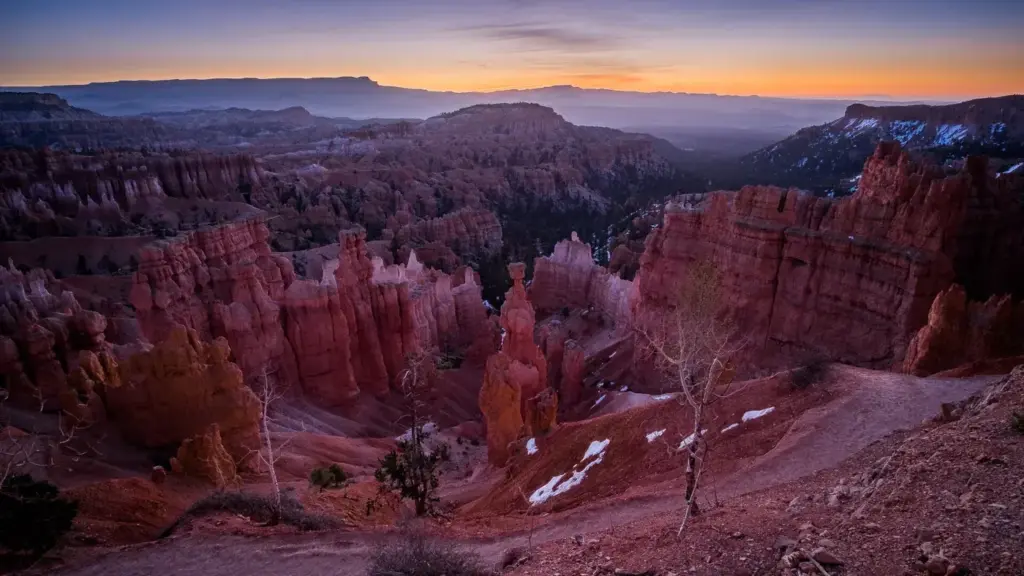
Wide angle lenses have short focal lengths, roughly 35mm or shorter on full frame, and they capture a broad field of view. They make near objects look larger relative to distant ones, which adds depth, but they also stretch things near the frame edges. They suit landscapes, interiors and architecture.
Why It Matters
Wide angle lenses let you include a whole room, a sweeping landscape or a tall building in one frame. They are also the lenses most often misused, because the strong perspective that makes them exciting also distorts faces and bends lines when handled carelessly.
A few simple habits control that effect, so you can use wide lenses to add drama on purpose instead of by accident.
Beginner Using A Wide Lens Well
On a full frame camera, lenses from 24mm to 35mm are called wide, and those under 24mm are ultra-wide. On a crop sensor, divide those numbers by about 1.5. The shorter the focal length, the more extreme the effects below.
What They Do To A Scene
- They include more of the scene, which helps in tight rooms and for big landscapes.
- They exaggerate the size difference between close and far objects, which creates depth.
- They make the background look farther away from the subject.
- They give a large depth of field, so much of the scene looks sharp even at moderate apertures.
Getting Strong Compositions
- Choose a clear foreground subject, such as a rock, flower or doorway. Wide lenses are weak when there is nothing to anchor the eye.
- Get close. Placing the subject only a foot or two from the lens makes it large against the distant scene.
- Keep the camera level to avoid slanted verticals on buildings. Tilting up makes towers lean inward.
- Keep people away from the corners, where faces and bodies stretch.
- Use f/8 to f/11 to keep both foreground and background sharp, and focus about one third into the scene.
Typical Uses
| Subject | Why A Wide Lens Helps |
|---|---|
| Landscapes | Fits sky, land and foreground in one frame |
| Interiors and real estate | Shows the whole room in small spaces |
| Architecture | Captures tall buildings from nearby |
| Street and documentary | Shows people in context of their surroundings |
| Night sky | Wide aperture and broad view cover large star fields |
Common Mistakes
- Standing back and including too much empty space, so the subject becomes small.
- Placing faces at the edge, which stretches them.
- Tilting the camera upward and creating converging vertical lines without meaning to.
- Forgetting a polarizing filter or hood can cause uneven skies on very wide lenses.
Wide Angle Settings To Remember
For scenery, set f/8 to f/11, ISO 100 and focus about a third of the way into the scene. For tight interiors, raise ISO a little and use a tripod, so you can keep the aperture small and the exposure long. For people in context, use f/4 to f/5.6, place them near the center and fill the foreground and background with environment. Check the horizon with the camera level, and turn on a grid or electronic level to help.
Handy for this: Wide-Angle Zoom Lens — take in the whole scene. (affiliate link)
Advanced Projection, Distortion And Verification
Why Wide Lenses Stretch Edges
A rectilinear lens keeps straight lines straight by projecting the scene onto a flat sensor. The cost is that image magnification grows toward the edges as the angle from the axis rises. At an angle of 45 degrees off axis, objects are stretched by roughly a factor of two relative to the center in the radial direction. This is called perspective distortion or stretching, and it is geometric, not a lens flaw. It also increases as focal length drops. A fisheye avoids stretching by bending straight lines instead, as described in fisheye lenses.
Barrel Distortion Versus Perspective
Do not confuse stretching with barrel distortion. Barrel distortion bows straight lines outward and comes from the lens design, while stretching alters the size and shape of objects at the edges. Distortion can be corrected with a lens profile in your editor, but perspective stretching cannot be fixed without changing the shot. For measurement and correction, see lens distortion.
Converging Verticals And Shift Control
When you tilt a camera up toward a building, the parallel vertical lines converge in the image. Keeping the sensor plane parallel to the wall prevents this. If the top of the building does not fit, a tilt-shift lens lets you shift the lens upward while keeping the camera level, which keeps the lines straight. See tilt-shift lenses for more.
Light Falloff, Corner Sharpness And Flare
Wide lenses often show darker corners, called vignetting, and softer corners at wide apertures. They also collect stray light from large angles, so the sun in or near the frame can cause flare and ghosting. Stopping down two stops usually improves corner sharpness and vignetting. See lens vignetting and lens flare.
Objective Checks
Photograph a flat wall or a grid on a tripod with the camera parallel to it. Straight lines should stay straight, corners should match the center in sharpness, and brightness should be even. Do this at each aperture you plan to use. The results show where your lens is at its best and where it needs correction.
Filters, Hoods And Stitching
Very wide lenses often have bulbous front elements that do not accept screw-on filters, so special holders or rear gel filters are used. A polarizer on a wide lens can darken part of the sky unevenly because the effect depends on the angle to the sun. If the view is still too narrow, shoot a series of overlapping frames and stitch them into a panorama. Keep the camera level, overlap each frame by about a third and use manual exposure and focus so every frame matches.
Try It
- Choose a room or street with strong lines and set your widest lens at f/8.
- Photograph the scene once from standing height with the camera level, then again tilted upward, and note how vertical lines change.
- Place a friend or object at the center, then at the corner, and compare how shapes stretch.
- Move closer to a foreground object and take a frame that uses the exaggerated depth for effect.
Common Questions
What focal length counts as wide angle?
On a full frame camera, 35mm and shorter is usually called wide, and under 24mm is ultra-wide. On a crop sensor, the same view needs a lens about one third shorter, such as 16mm for an APS-C camera.
Why do faces look stretched with wide lenses?
Edges of the frame are magnified more than the center, so objects near them look wider. Keep faces near the middle of the frame, or use a longer lens for portraits.
How do I keep buildings from leaning?
Keep the camera level so the sensor stays parallel to the wall. If you cannot fit the building, step back, use a tilt-shift lens or correct the verticals in editing software.
Are wide angle lenses good for landscapes?
Yes. They show broad scenes and can emphasize a foreground object against a distant background. They work best with a strong foreground, a level horizon and a small aperture for depth.
Related Lessons
- Focal Length Explained for how focal length sets the view.
- Lens Distortion for correcting barrel and pincushion shapes.
- Fisheye Lenses for an extreme wide view that curves lines.
- Tilt-Shift Lens to keep verticals straight on buildings.
- Lens Vignetting to understand dark corners on wide lenses.
Gear That Helps With This
Hand-picked kit that makes this lesson easier to put into practice.
Some links are affiliate links: if you buy through them we may earn a small commission at no extra cost to you. How this works.