
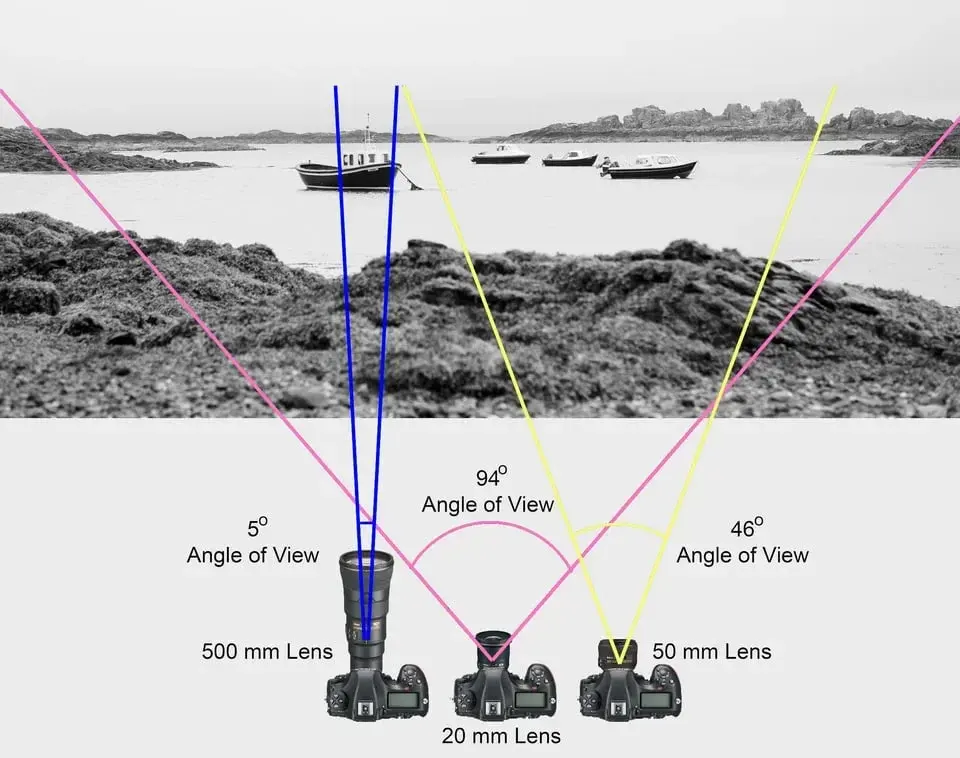
Focal length explained simply: it is the distance in millimeters from the lens optical center to the sensor when focused at infinity. A short focal length such as 24mm gives a wide field of view with small subjects, and a long one such as 200mm gives a narrow view with larger subjects.
Why It Matters
Focal length is the first number you see on any lens, and it decides what fits in the frame. Choosing the wrong one means you either cannot fit the scene or cannot get close enough to the subject.
Understanding it also clears up many myths about lenses, such as what changes when you zoom and why the same lens looks different on different cameras.
Beginner What The Millimeters Mean
You will see numbers like 18mm, 35mm, 50mm and 200mm. They describe how the lens bends light to form an image, but for everyday use you only need to remember the effect: lower numbers see wider, higher numbers see narrower and make subjects larger in the frame.
Typical Ranges
| Focal Length (Full Frame) | Category | Common Use |
|---|---|---|
| 14 to 24mm | Ultra-wide to wide | Landscapes, interiors, architecture |
| 28 to 35mm | Moderate wide | Street, travel, environmental portraits |
| 40 to 60mm | Standard | General use, a natural look |
| 70 to 135mm | Short telephoto | Portraits |
| 200mm and longer | Telephoto | Sports, wildlife, distant subjects |
Field Of View
Field of view is how much of the scene fits in the picture. On a full frame sensor, a 24mm lens covers about 84 degrees across the diagonal, a 50mm lens about 47 degrees, and a 200mm lens about 12 degrees. As focal length rises, the angle shrinks, so the scene appears more zoomed in.
Magnification And Distance
A longer lens makes the subject larger in the frame without you moving. A 100mm lens shows a subject roughly twice as large as a 50mm lens from the same spot. You can also fill the frame with a wide lens by walking closer, but the look of the picture will differ, as covered in the lesson on telephoto compression.
Choosing A Focal Length
- Decide what has to fit in the frame, such as a room, a group of people or a single face.
- Check whether you can move. If you cannot step back, you need a wider lens. If you cannot step forward, you need a longer one.
- Consider the background. A longer lens shows less of it, so it can hide clutter.
- Think about shutter speed. Longer lenses magnify shake, so aim for at least 1 divided by the focal length in seconds when handheld, such as 1/200 second for 200mm.
Common Mistakes
- Believing that zooming in changes perspective. It does not. Only moving changes perspective.
- Ignoring crop factor and comparing lenses across different sensor sizes.
- Choosing a wide lens for portraits and stretching faces near the edges.
- Forgetting that a zoom lens range is only useful if you actually change it for each shot.
Zoom Ranges In Practice
Many photographers find that they use only a few focal lengths again and again. Kit zooms such as 18-55mm are often used at the ends of the range, so a wide and a standard prime may suit you better. Check the image data in your photo library to see which numbers you use most. That list makes a good guide for choosing your next lens.
Handy for this: Fast Prime Lens — creamy backgrounds, low light. (affiliate link)
Advanced Optics, Crop Factor And Equivalence
Focal Length Explained: The Optical Definition
For a simple thin lens, focal length is the distance from the lens to the point where parallel rays from a far-off subject meet. Real camera lenses contain many elements, so the number refers to the effective focal length measured from a principal plane, not the physical barrel length. This is why a 400mm telephoto can be shorter than 400mm, using a telephoto design that places the principal plane in front of the glass.
Field Of View Formula
The angle of view across a dimension d of the sensor is 2 times the arctangent of d divided by twice the focal length. On a full frame sensor, the 43.3mm diagonal and a 50mm lens give about 47 degrees. A smaller sensor with a shorter diagonal gives a narrower angle with the same lens, which is why crop sensor cameras appear to zoom in. The crop factor is the ratio of the full frame diagonal to the sensor diagonal, roughly 1.5 for APS-C and 2 for Micro Four Thirds. See crop factor and equivalence for how to compare lenses across formats.
Magnification And Image Size
For a distant subject, the image size on the sensor is approximately focal length times subject size divided by distance. Doubling focal length doubles the subject’s size on the sensor. This also explains why long lenses make background objects appear closer: they enlarge distant detail without changing the geometry, which depends only on where you stand.
Focal Length And Perspective
Perspective, meaning the relative size and spacing of near and far objects, depends on camera position only. Focal length simply sets how much of that view you crop in. If you stand in the same spot with a 24mm and a 100mm lens, the 100mm picture is a crop of the 24mm picture, apart from resolution. Compare wide-angle lenses and telephotos to see how position drives the look.
Aperture, Depth Of Field And Focal Length
The f-number is focal length divided by the aperture diameter. A 100mm f/2 lens has a 50mm opening. At the same subject distance, longer focal lengths have shallower depth of field, but if you fill the frame the same way by moving, depth of field depends mostly on aperture and subject magnification. This is detailed in controlling depth of field.
Focal Length And Image Stabilization
Longer focal lengths magnify camera shake, so stabilizers matter most for telephotos. In-lens or in-body stabilization can give around three to five stops of extra handholding ability, but it does not freeze subject motion. For a 200mm lens, the rule of thumb suggests 1/200 second, and stabilization may let you use 1/25 second for a still subject. For moving subjects, keep the shutter speed fast regardless of stabilizer claims.
Try It
- Stand in one spot and photograph the same scene with a zoom lens at its widest, middle and longest settings.
- Note how the field of view changes, and crop the widest frame to match the longest to confirm that perspective stayed the same.
- Now move so that a person fills the frame at both ends of the zoom and compare how the background and face shape differ.
- Write down the focal lengths you used most, and use that range to choose your next lens.
Common Questions
What does focal length mean on a camera lens?
It is a number in millimeters that describes the lens optical design. In practice it tells you how wide the view is: low numbers see more of the scene and high numbers see a smaller, magnified part.
Does a longer focal length mean better zoom quality?
Not necessarily. Longer focal length simply magnifies more. Image quality depends on the lens design and sharpness, and long lenses are also harder to hold steady and need faster shutter speeds.
Does focal length change on a crop sensor?
The actual focal length stays the same, but the field of view is narrower because the sensor is smaller. A 50mm lens on an APS-C body looks like about 75mm on full frame.
Is 50mm the same as what my eyes see?
It is close in terms of perspective and the apparent size of objects, but human vision covers a much wider area than a 50mm frame. The number is a convenient reference, not an exact match.
Related Lessons
- Crop Factor And Equivalence for comparing lenses on different sensors.
- Wide-Angle Lenses to learn how short focal lengths behave.
- Telephoto Compression to see what long lenses really do to perspective.
- Prime Vs Zoom Lenses for choosing between fixed and variable focal length.
- The 50mm Lens for a close look at the standard focal length.
Gear That Helps With This
Hand-picked kit that makes this lesson easier to put into practice.
Some links are affiliate links: if you buy through them we may earn a small commission at no extra cost to you. How this works.