
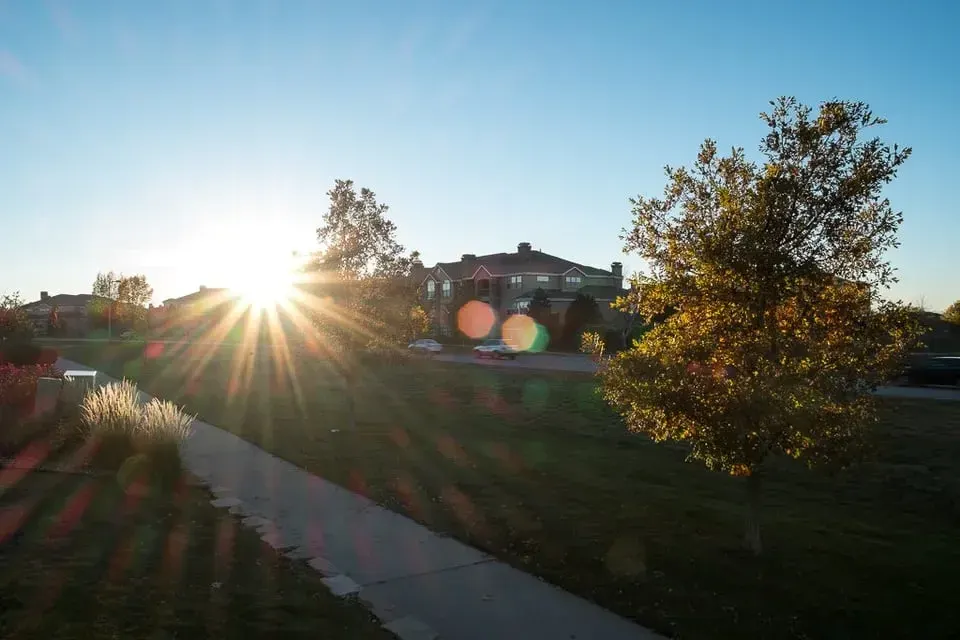
Lens flare is the haze, streaks or bright shapes that appear when strong light, usually the sun, bounces between lens elements and the sensor instead of passing straight through. It can lower contrast and add colored ghosts, so photographers either block it with hoods and angles or use it deliberately for mood.
Why It Matters
Flare can ruin a frame by washing out shadows and adding distracting shapes, or improve it by adding warmth and a sense of light. Whether it is a problem or a style choice depends on whether you control it.
Understanding the causes lets you prevent unwanted flare in tricky light and produce attractive flare when you want it. It also helps you judge lenses, since coatings and design differ widely.
Beginner Lens Flare And Ghosting Basics
Two Kinds Of Flare
– Veiling flare is a low-contrast haze across the picture. Blacks turn gray, colors lose punch.
– Ghosting shows up as shapes, often matching the aperture, in lines pointing toward the light source. These are reflections off lens surfaces.
When It Happens
Flare appears when a bright light is in the frame or just outside it, particularly when it shines directly onto the front element. It is more likely with dirty lenses, scratched coatings, extra filters and complex zooms with many glass elements.
How To Reduce Flare
1. Use a lens hood, which blocks light from outside the frame.
2. Shade the front element with your hand, a hat or a card, taking care not to enter the picture.
3. Change your position so the light source sits behind an object such as a tree or building.
4. Remove any filter that is not needed, especially cheap clear protectors.
5. Clean the front and rear lens elements with a microfiber cloth.
6. Try a different angle, since a small shift can eliminate a ghost.
Using Flare Creatively
Place the sun partly behind a branch, a building edge or a person to produce a soft glow. A smaller aperture such as f/11 or f/16 turns the sun into a sharp starburst. Warm flare at golden hour adds a dreamy feel to portraits, and many photographers set their exposure so that the haze lifts shadows gently.
Common Mistakes
– Judging flare on the camera screen in bright sun, where it is hard to see.
– Leaving a hood off for convenience.
– Using a dirty lens that scatters light into a haze.
– Shooting straight into the sun at a wide aperture and expecting a crisp sunstar.
Handy for this: Carbon Fiber Tripod — sharp at slow shutter speeds. (affiliate link)
Advanced The Optics Of Flare And Ghosting
Internal Reflections
Each glass to air surface in a lens reflects a small portion of light, typically 4 percent without coating. In a lens with 12 or more surfaces, those reflections add up. Some of the reflected light bounces twice and lands on the sensor as a faint image of the aperture, a ghost. Sensor and filter surfaces can also reflect light back into the lens. Because ghosts mirror the aperture, their shape reveals the number of blades and the aperture setting.
Coatings Reduce Flare
Anti-reflective coatings use thin layers whose thickness cancels reflected wavelengths. Multi-coating and nanostructure coatings can reduce reflectance per surface to under 0.5 percent. Modern lenses flare far less than older ones, but extreme light can still cause it. Read about the technology in lens coatings and the filter problem in camera filters.
Starbursts And Aperture Blades
When the aperture is stopped down, light diffracts around the blade edges and forms spikes. A lens with an even number of blades produces as many spikes as blades. A lens with an odd number produces twice as many, since the spikes do not overlap. A nine-blade lens gives 18 points. The effect is strongest when the light is a small point, and it needs a small aperture. See aperture and f-stops for how stops change the opening.
Flare And Lens Design
Zooms with many elements, wide-angle lenses with a bulging front element and vintage lenses with single coatings flare readily. Prime lenses with simple designs and good coatings resist it. Some cinematographers choose old or anamorphic lenses for their distinctive streaks, such as the horizontal blue line from anamorphic glass. See vintage lenses and anamorphic lenses.
Removing Flare In Editing
You can reduce haze by adding contrast, lowering blacks or using a dehaze slider selectively on the affected area. Ghost shapes can be cloned out when the background is simple. For a clean result, shoot a second frame with the sun blocked by a hand or card, and blend it into the first where needed, which works well for tripod shots.
Using The Hood Correctly
A hood is designed for a specific focal length and format. On zooms it often suits the widest setting, so at telephoto it may not shade fully. Make sure it is seated correctly, and consider an additional flag or a matte box for video. See lens hood for shapes and sizes, and rim light and silhouettes for backlit work.
Flare In Video
Flare behaves differently in motion because it shifts as the light moves relative to the lens. In video, a slow pan past the sun creates an animated ghost sequence, which can look beautiful or intrusive. Cinematographers use flags, French flags and matte boxes to shade lenses, and they often position them just outside the frame. If a flare appears in the middle of a shot you cannot repeat, you can often reduce it in grading with a power window and lowered lift.
Sensor And Filter Reflections
Not all flare comes from the lens. The sensor’s cover glass, the microlenses and the low-pass layer can reflect a small amount of light back into the lens, and the lens then reflects it again onto the sensor. This is why two bodies can show different ghost patterns with the same lens. Dirty or smudged rear elements and sensor dust add haze too, so keep both clean, and use a blower first, a swab only when needed.
Shooting Into The Sun Safely
Looking at the sun through an optical viewfinder can hurt your eye, and the focused sun can damage a sensor or shutter if left aimed at it for long. Use live view or an electronic viewfinder, shoot quickly and cap the lens between frames. Expect bracketing to be useful, since the metering will struggle. A shot with the sun in the frame often needs a spot reading on a mid tone, then a check of the histogram.
Practical Starting Settings
For a sunstar, try f/13 to f/16, base ISO and a short exposure with the sun peeking from behind an edge. For a soft, glowing look, use f/2 to f/4 and let the light hit the lens at an angle. Always review at full size, since a small ghost spot may show only when zoomed in.
Try It
- On a sunny day, photograph a tree with the sun just outside the frame, once with the hood on and once without.
- Move the sun behind a branch and shoot at f/2.8, f/8 and f/16, comparing the glow and starburst.
- Take a frame with a clean lens, then smudge a thumbprint on a spare filter and shoot again.
- Compare contrast in the shadows across all frames.
Common Questions
What causes lens flare?
Bright light bouncing between glass surfaces inside the lens and between the lens and sensor. It happens most when a strong light source shines onto the front element.
Does a lens hood prevent all flare?
No. It blocks stray light from outside the frame, but it cannot stop flare from a light source inside the picture. Shade the lens or change angles for those cases.
How do I get a sunstar?
Use a small aperture such as f/11 to f/16 and place the sun partly behind an object so only a small point shows. The number of points depends on the aperture blades.
Why do some lenses flare more than others?
Lens design and coatings matter. Complex zooms, older lenses and uncoated or damaged surfaces reflect more light and flare more than modern coated primes.
Related Lessons
- Lens Coatings for how modern glass resists reflections.
- Lens Hood to block light from outside the frame.
- Camera Filters Guide for filters that can add ghosting.
- Vintage Lenses for classic flare character.
- Rim Light And Silhouettes for planning backlit shots.
Gear That Helps With This
Hand-picked kit that makes this lesson easier to put into practice.
Some links are affiliate links: if you buy through them we may earn a small commission at no extra cost to you. How this works.