
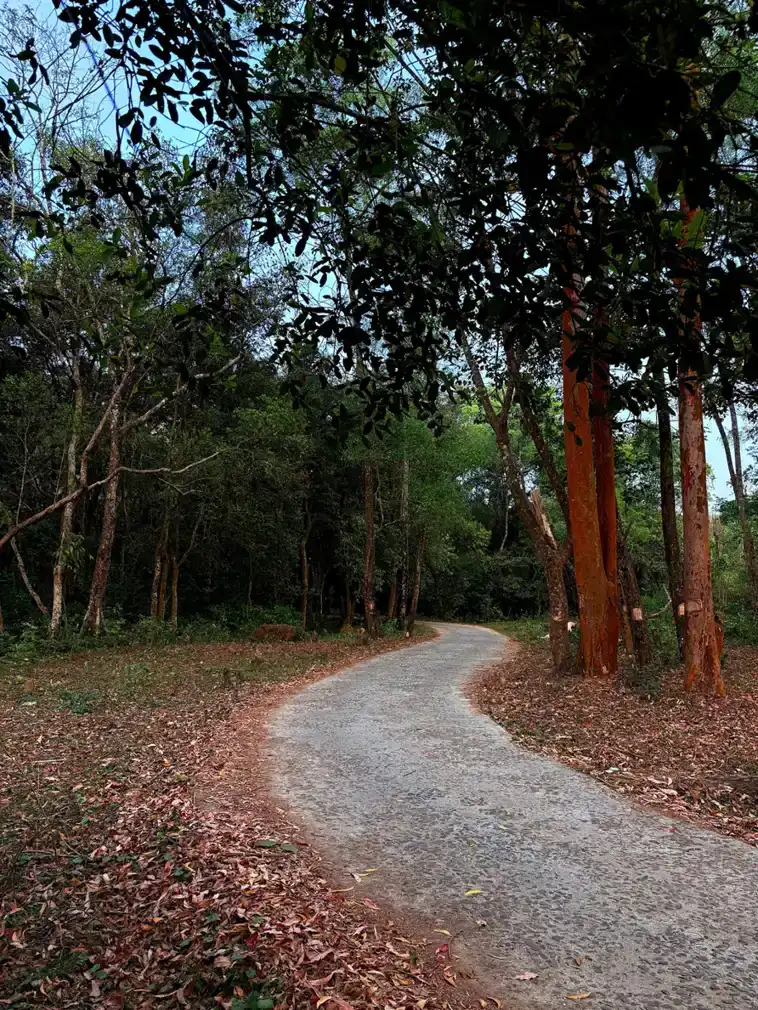
Leading lines are visible or implied lines in a scene, such as a road, a fence, a river or a row of lights, that guide the viewer’s eye toward your subject. They work by giving the eye a path to follow, so attention travels from the edge of the frame toward the point where the line ends.
Why It Matters
A photograph is a flat surface, and viewers decide in a second or two where to look. Without help their eyes wander. Leading lines supply direction, which also gives the picture depth and a sense of movement.
The skill is not just spotting a line. It is making sure that the line ends at something worth looking at and that it does not carry the viewer straight out of the picture.
Beginner Finding And Using Leading Lines
Look for any strong, continuous shape that travels across the scene. Roads, rails, piers, fences, stairs, shorelines, walls, rows of trees and shadows are common examples. Lines can also be implied, such as a row of footprints or the direction a person is pointing.
Where To Look
- City: sidewalks, crosswalks, building edges, bridges and the lines of a train platform.
- Countryside: paths, fences, streams, furrows in a field and the edge of a ridge.
- Indoors: hallways, floorboards, ceiling beams, staircases and table edges.
- Nature close up: stems, a curling vine or the veins of a leaf.
How To Compose With Them
- Spot a line and walk to the end where it begins. Starting near a corner of the frame, such as the lower left, gives the longest path for the eye.
- Decide on the destination. It should be your subject, such as a person, a lone tree or a distant building.
- Lower the camera toward the ground and the line looks longer and stronger. A higher viewpoint can make a line look shorter.
- Check every edge of the frame. Make sure the line enters cleanly and does not run out to the side before reaching the subject.
- Take the shot, then take another from a slightly different position so you can compare.
| Type of line | Effect | Example |
|---|---|---|
| Straight, converging | Strong depth and pull | Railway tracks |
| Curving | Gentle, relaxed flow | A winding river |
| Diagonal | Energy and movement | A staircase |
| Horizontal | Calm, stable feeling | A pier at dusk |
| Implied | Subtle direction | A person looking out of frame |
Choosing The Destination
A line is only as good as the place it leads. The end point can be a person standing on a path, a lighthouse at the end of a pier, a bright window at the end of a hallway or a mountain peak beyond a river. Because the eye also notices contrast, a bright or colorful subject at the end of the line makes the pull even stronger. If the subject is small, the line does the work of making it important, so a tiny figure at the end of a long road can anchor the whole picture.
It also helps to think about where the line begins. A line that starts at the bottom edge invites the viewer into the picture, almost like an entrance. This is why foreground paths and rivers work so well in landscapes, and you can read more about building that entrance in the lesson on foreground interest.
Common Mistakes
- Using a line that points to empty space or to a distracting object.
- Letting a line run out of the frame, which carries the eye away.
- Choosing too many competing lines, so nothing has a clear goal.
- Putting the subject in the middle of a line when it would read better at the end.
Handy for this: Macro Lens — fill the frame with detail. (affiliate link)
Advanced Convergence, Lens Choice And Lines That Leave
Why Lines Converge
Parallel lines in the real world, such as the two rails of a track, appear to meet at a vanishing point on the horizon because of perspective. The more of the scene’s depth you include, the stronger the convergence. This is why leading lines tend to look dramatic in photos that include a close foreground and a distant background. If you shoot straight down a road, the vanishing point sits at the horizon, and placing your subject there gives a direct and powerful pull.
Lens Choice
A wide-angle lens exaggerates the difference in size between near and far, so lines appear to rush toward the center. A 16mm or 24mm lens on a full-frame camera makes a path look like it runs forever. A telephoto lens compresses distance and makes lines look flatter and more parallel, which is useful for stacking repeating shapes such as a row of lamp posts. Compare the two in the lessons on wide-angle lenses and telephoto compression.
Lines That Exit The Frame
A line that leaves the frame at an edge or corner acts as an exit sign. The eye follows it out of the picture, and the photo feels unfinished. To prevent this, either end the line at the subject, or let it fade into soft focus or darkness, or crop so that it enters at a corner and finishes inside the image. When the line has to cross the frame, a strong subject at its end holds the eye in place.
Combining Lines With Other Tools
Leading lines pair well with other devices. A subject at the end of a line can sit on a third line, as in the rule of thirds, and a line can form part of an S curve, covered in S-curve composition. Be aware of tangents, where a line just touches another edge and creates a confusing join.
Tilt And Straight Lines
Verticals that lean can distract, but diagonal lines are most effective when you commit to them. Tilting the camera a few degrees to turn a nearly horizontal line into a clear diagonal looks like a mistake, so either keep it level or tilt decisively. Always check that real vertical lines such as building walls are upright unless you are using their lean as part of the effect.
Try It
- Find a road, path, hallway or fence near you and shoot it from standing height.
- Crouch to ground level and shoot the same line again.
- Switch to a wide lens or wide zoom setting, then a longer setting, and keep the same subject at the end of the line.
- Compare the four images and note which version makes the line feel longest and which keeps the eye inside the frame.
Common Questions
What are leading lines in photography?
They are lines in a scene, real or implied, that draw the viewer’s eye along a path to the main subject. Roads, fences, rivers, stairs and rows of objects are common examples.
Do leading lines have to be straight?
No. Curves such as rivers and winding paths lead the eye in a gentler way. Straight converging lines give strong depth, while curved ones feel relaxed.
Which lens is best for leading lines?
A wide-angle lens exaggerates convergence and works well for dramatic lines. A telephoto lens flattens them, which suits repeating patterns. Pick the one that fits the feeling you want.
Why does my photo feel like the eye leaves it?
A line likely exits the frame at an edge. End the line at your subject, let it fade into shadow or blur, or move so it enters at a corner and finishes inside the picture.
Related Lessons
- Visual Flow to chain lines into a path through the frame.
- Diagonal Composition to add energy with slanted lines.
- S-Curve Composition to use winding lines for a graceful path.
- Wide-Angle Lenses to exaggerate depth and convergence.
- Tangents in Composition to avoid awkward joins between lines.
Gear That Helps With This
Hand-picked kit that makes this lesson easier to put into practice.
Some links are affiliate links: if you buy through them we may earn a small commission at no extra cost to you. How this works.