
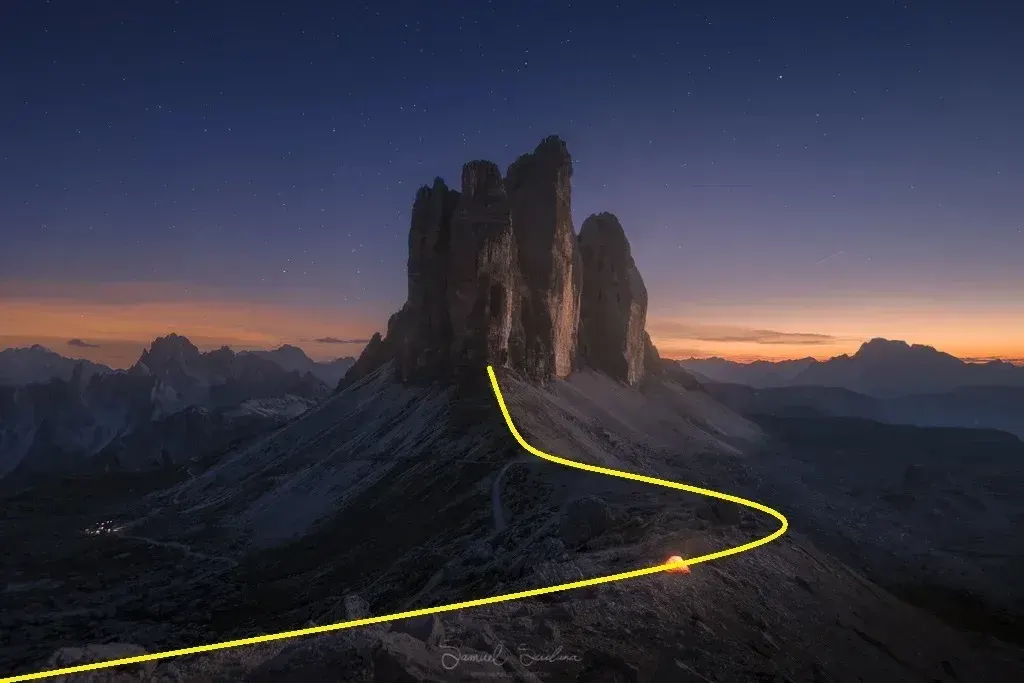
S-curve composition is a way of framing a photo so a graceful S-shaped line, such as a river, road, shoreline or body pose, guides the viewer’s eye through the image from foreground to background. It adds depth, rhythm and a natural sense of flow, and works well in both landscapes and portraits.
Why It Matters
The eye follows lines. A straight line leads quickly, while an S-shaped line slows the viewer and creates a longer journey through the frame. This gives a photo depth and a feeling of calm movement.
S-curves also appear everywhere in nature and in people. Learning to see them helps you choose better viewpoints, make simple scenes more interesting and pose people in a graceful way, without complicated equipment.
Beginner Seeing And Framing S-Curves
What Makes An S-Curve
An S-curve has two gentle bends in opposite directions. It starts near the bottom of the frame and winds toward the upper part. Because the line changes direction, the eye travels along it and moves across the picture.
Where To Find Them
– Rivers and streams winding through valleys.
– Roads and paths on hills.
– Coastlines and beach edges.
– Sand dunes and snow ridges.
– Railway tracks and fences.
– The curve of a person’s body and clothing.
Basic Steps
1. Look for a line that bends in two directions.
2. Move to a higher or lower viewpoint until the curve is clear.
3. Start the curve near a bottom corner or edge.
4. Let it lead toward a point of interest, such as a mountain, a building or a face.
5. Check that the curve is not cut off awkwardly.
Simple Tips
Place the beginning of the curve in the foreground so it feels like an invitation to enter the scene. Keep the frame clean, and remove distracting objects that cut across the line.
Common Mistakes
– Cropping the curve so its beginning or end is lost.
– Standing at a level height where the curve looks flat.
– Letting a bright object at the edge pull the eye away.
– Seeing only the curve and ignoring the main subject.
Handy for this: Wide-Angle Zoom Lens — take in the whole scene. (affiliate link)
Advanced Using S-Curves In Landscapes And Portraits
Finding The Right Angle
The same river can look straight or curved depending on where you stand. Climb a little higher, use a bridge or a hill, and step sideways until the bends line up. A higher viewpoint often shows the S-shape more clearly, as explained in camera angle in photography. In a narrow valley, moving a few steps can change the whole curve.
Lens Choice
A wide-angle lens exaggerates the foreground and makes a curve seem to rush toward the distance, which suits dramatic scenes, as discussed in wide-angle lenses. A longer lens compresses the scene and flattens the curve, which gives a more graphic, abstract look, useful for rivers seen from far away or road bends on hills. Choose by the feeling you want: depth with wide, pattern with long.
Combining With Other Ideas
S-curves work with other composition tools. A curve can lead to a subject placed on a third, as in the rule of thirds. It is a softer cousin of leading lines, and it differs from the straighter energy of diagonal composition. Combining several ideas can give a layered image, but keep the picture simple enough that the curve stays the hero.
Light And Time Of Day
Low sun creates long shadows and highlights that define the curve, such as a road edge catching light. Mist can soften the background and make the curve stand out. Midday sun can flatten textures, so look for contrast between the curve and its surroundings, such as a dark river against pale grass.
Portraits And Poses
In portraits, an S-curve appears when a person shifts weight to one leg, tilts the hips and shoulders in opposite directions, and lets the head tilt gently. This creates a flowing line from head to feet. Guidance for directing subjects is in posing portraits. Keep the pose natural, and avoid exaggerated arches. Clothing, hair and a scarf can add curves too.
Processing
In editing, you can strengthen an S-curve by darkening the edges, brightening the path and keeping contrast along the line. Avoid heavy vignettes. Cropping can refine the composition, but start with a good frame in the camera.
When To Break The Pattern
Not every scene needs an S-curve. A single strong diagonal or a calm symmetrical frame may fit better. Practice recognizing the shape, then decide whether it helps the story. Read breaking composition rules for when to ignore guidelines.
Practice Ideas
Visit a local park, riverbank or hill and shoot ten photos of curving paths. Move to a higher point, change lenses and compare. Review the results and choose the three where the eye travels most smoothly through the frame.
Summary
Find a curve, choose a viewpoint that shows both bends, start it near the foreground and lead it to a subject. A clean frame and gentle light complete the picture.
Seasonal And Weather Ideas
Winter snow turns a path or river into a clean white curve against dark trees, which makes it easy to read. In autumn, a road with colored leaves has a natural S-shape, while mist in spring can hide distant bends and give a soft sense of mystery. Look at the same location in several conditions, since the curve may stand out much more at one time than another.
Urban And Abstract Curves
S-curves are not only in nature. Staircases, elevated roads, tram lines and building edges often follow flowing shapes. Shoot from a footbridge or a window to see the curve more clearly. Close-ups of patterns, such as rippled sand or folded fabric, can also form small S-shapes that make attractive abstract pictures.
Checking Your Result
After shooting, look at a small version of the image, or squint at it, and see where your eye travels. If it follows the curve to the main subject and stays inside the frame, the composition works. If it slides out of the corner, adjust the angle or crop so the end of the line stays within the picture.
Try It
- Find a winding path, river or road near you.
- Photograph it from eye level, then from a higher position, and compare the shapes.
- Try a wide lens and a longer lens from the same spot.
- Choose the version where the curve guides your eye best and note why.
Common Questions
What is S-curve composition?
It is a composition technique where an S-shaped line, such as a river, road or body pose, leads the viewer’s eye through the frame from foreground to background.
Where does an S-curve work best?
It works well in landscapes with winding rivers, paths and coastlines, and in portraits where a gentle pose creates a flowing line.
Do I need a wide-angle lens for an S-curve?
No. Wide lenses add depth, while longer lenses compress the scene and give a more graphic, flattened curve.
How is an S-curve different from leading lines?
Leading lines are often straight and direct, while an S-curve bends in two directions and slows the eye, giving a gentler flow.
Related Lessons
- Leading Lines for a related guiding technique.
- Diagonal Composition for a more energetic line.
- Rule Of Thirds Composition to place the end of the curve.
- Camera Angle In Photography to find a clearer viewpoint.
- Posing Portraits to create curves in people.
Gear That Helps With This
Hand-picked kit that makes this lesson easier to put into practice.
Some links are affiliate links: if you buy through them we may earn a small commission at no extra cost to you. How this works.