
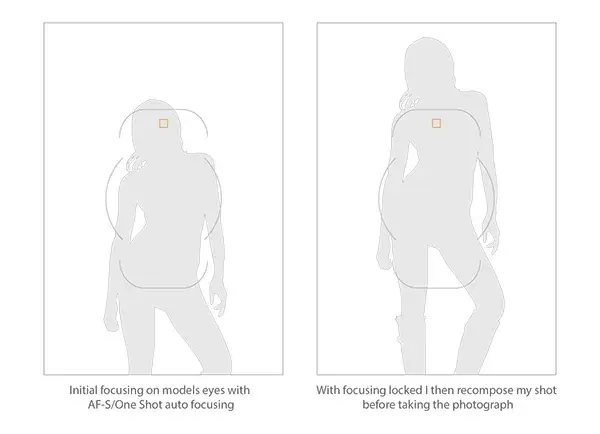
Focus and recompose is a technique in which you aim the focus point at your subject, lock focus by half-pressing the shutter or using a back button, then move the camera to frame the picture before taking the shot. It is fast and works well at moderate apertures, but it can cause missed focus at wide apertures and close distances.
Why It Matters
Many cameras have focus points clustered near the center, and the best composition often places the subject off-center. Focus and recompose lets you use the most accurate center point and still place your subject where you want in the frame. It has been used for decades, and it is a useful skill for portraits, events and street work.
But the technique has a weakness. When you swing the camera, the distance between the camera and the subject changes slightly, and with a shallow depth of field that can be enough to make the eyes soft. Knowing when it works is the key.
Beginner Using Focus And Recompose
How It Works
- Choose single-shot autofocus, often called AF-S or One Shot.
- Place the center focus point on your subject, such as an eye.
- Half-press the shutter button, or press the back button, until focus confirms.
- Keep holding, then move the camera to the composition you want.
- Press the shutter fully to take the picture.
Why Focus Can Shift
The focus plane is flat, not curved. When you rotate the camera around your body while keeping the same position, the distance between the lens and the subject becomes slightly shorter or longer, and the point you focused on moves out of the plane of focus. The effect is greatest when the subject is close, the aperture is wide, and the camera moves a long way.
| Situation | Risk of missed focus |
|---|---|
| Subject far, f/8 or smaller | Low |
| Portrait at f/4 | Moderate |
| Close-up at f/1.8 | High |
| Small recompose angle | Lower |
| Large recompose angle | Higher |
Good Situations For Focus And Recompose
- Landscapes and travel photos at moderate apertures.
- Group photos at f/5.6 or smaller.
- Street photography with zone focusing.
- Subjects that stay still while you reframe.
- Cameras with few or clustered focus points.
Common Mistakes
- Using it at f/1.4 for close portraits and getting soft eyes.
- Letting go of the half press and refocusing on the background.
- Using continuous autofocus, which refocuses as you move.
- Rotating the camera too much instead of making small changes.
A Quick Exercise
Photograph a friend at three apertures, f/2, f/4 and f/8, using focus and recompose with the same movement. Zoom in on the eyes and see where sharpness drops.
Handy for this: Carbon Fiber Tripod — sharp at slow shutter speeds. (affiliate link)
Advanced Improving Accuracy And Alternatives
Reducing The Error
Keep the movement small, and where possible, pivot the camera by moving your whole body slightly rather than only twisting the camera. Increase your distance from the subject and use a longer focal length with a smaller angle. Stop down the aperture to increase depth of field, since an extra stop gives more tolerance. Review the first shot at high magnification to confirm the eyes are sharp. See depth of field and aperture explained.
Using The Back Button
Back button focus separates focusing from the shutter, so you can focus once and keep the lock while you recompose with no risk of the shutter refocusing. It also allows continuous autofocus when needed. Set it up in the camera menu and practice until it is automatic. See back button focus and autofocus modes.
Better Alternatives
Move the focus point instead. Modern mirrorless cameras provide hundreds of points across the frame, and eye detection, so you can place the point on the eye and compose normally. Touch screens let you tap the subject, and joysticks let you move the point quickly. Subject tracking can follow a moving person while you frame. See eye autofocus, choosing focus points and tracking autofocus.
Handling Shallow Depth Of Field
At f/1.4 to f/2, even a few centimeters matter. For these shots, use an off-center focus point, or focus first and then adjust your position by moving the whole body to keep the distance constant. Manual focus with focus peaking can also help in stable situations. See fast lenses, bokeh explained and manual focus techniques.
Focus And Recompose In Video
Video changes the rules, since the camera is moving while recording. Use autofocus tracking or a follow focus rather than locking and moving. If you must lock, use a smaller aperture to widen the zone of acceptable focus, and keep subject distance steady. See follow focus basics and rack focus.
Testing Your Own Equipment
Mount the camera on a tripod and photograph a ruler or a printed focus chart at an angle. Use focus and recompose at different apertures, and see where the sharpest point lands. This shows how much margin your lens gives, and helps you choose a safe aperture for portraits. Repeat at different distances to see how the error changes.
Habits That Help
Compose first, check the focus, and confirm with magnified review. Keep the camera steady and breathe out before the shutter press. Pick a method, whether back button focus, focus point selection or recompose, and practice until you can use it without looking away from the subject.
Practical Tips From Different Genres
In portrait work, focus on the nearer eye and recompose only a little. In wedding and event shooting, the speed of focus and recompose helps when people move quickly, but check the sharpness often. In landscape photography, focus about a third of the way into the scene at a small aperture, then recompose, because the depth of field covers the foreground and distance. For street photography, pre-focus on a spot where people will walk, using zone focusing, rather than focusing on each person.
Signs That The Technique Is Failing
- Eyes are sharp in the first frame of a series but soft in later frames.
- The background looks sharper than the face.
- Results vary between shots with identical settings.
- Close portraits at f/1.8 always miss.
If you notice any of these, switch to moving the focus point or increase the aperture value. Small changes in method often produce large improvements in how many photos are usable.
Try It
- Set single-shot autofocus and lock focus on an eye, then recompose and shoot at f/2.8.
- Repeat at f/8 and compare the sharpness at 100 percent.
- Switch to moving the focus point to the eye and compare the results.
- Set up back button focus and repeat the exercise.
Common Questions
What is focus and recompose?
It is locking focus on a subject with the center point, then moving the camera to a different composition before taking the picture.
Why are my eyes soft after recomposing?
At wide apertures the depth of field is very shallow, and moving the camera changes the distance to the subject enough to shift the focus plane.
Does focus and recompose work with mirrorless cameras?
It works, but eye autofocus and wide coverage focus points often make it unnecessary and more accurate to move the focus point.
Which aperture is safest?
f/5.6 or smaller is safer for portraits and group shots. Wide apertures need more care.
Related Lessons
- Back Button Focus to lock focus without the shutter.
- Eye Autofocus to place focus on the eye automatically.
- Autofocus Modes to choose between single and continuous.
- Depth Of Field to understand how shallow focus affects accuracy.
- Aperture Explained for choosing a safer f-stop.
Gear That Helps With This
Hand-picked kit that makes this lesson easier to put into practice.
Some links are affiliate links: if you buy through them we may earn a small commission at no extra cost to you. How this works.