
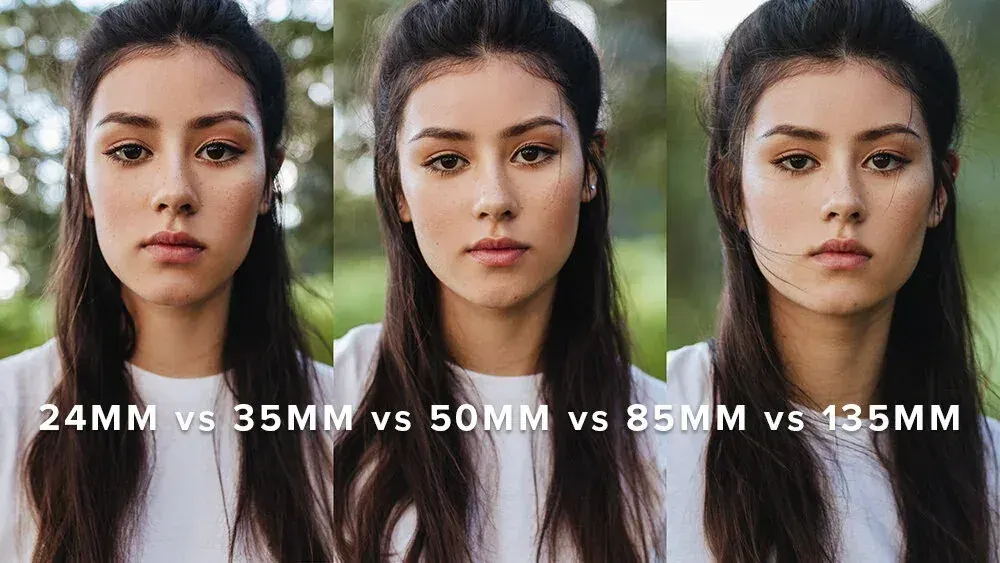
Portrait focal length is the lens length used to photograph people, and it changes facial proportions, background compression and how close you stand. On full frame, 85mm to 135mm is the classic range because it flatters faces, but 35mm to 50mm suits environmental portraits and longer lenses give more compression.
Why It Matters
Focal length does not change a face by itself. The distance from the camera to the subject does, and focal length determines how far you need to stand to frame the shot. Standing close with a wide lens exaggerates the nose and forehead, while standing farther back with a longer lens renders features more naturally.
Choosing the right length helps you control the look, the background and the comfort of the person you photograph. It also helps you plan lens purchases around the kind of portraits you want.
Beginner Focal Lengths For Portraits
Common Choices On Full Frame
| Focal Length | Look | Typical Use |
| 24mm to 35mm | Wide, includes surroundings | Environmental portraits |
| 50mm | Natural view, versatile | General portraits |
| 85mm | Flattering, good blur | Head and shoulders |
| 105mm to 135mm | Compressed, strong blur | Headshots, tight portraits |
| 200mm | Very compressed | Outdoor, candid work |
Why 85mm To 135mm Is Popular
At these lengths, you stand a few meters from the subject for a head and shoulders frame. This distance keeps facial proportions natural, avoids distortion and gives pleasant background blur at wide apertures. The subject also feels more comfortable than with a lens inches from the face.
Crop Sensors
On a crop sensor camera, the same view needs a shorter lens. A 56mm lens on an APS-C body gives about the same view as an 85mm on full frame. See crop factor equivalence for conversions.
Working Distance
A longer lens needs more space. Indoors, you may not have room for 135mm. In that case choose 50mm or 85mm and step back as far as possible. Outdoors, you can use longer lenses and let the background compress.
Common Mistakes
– Using a wide lens very close to a face, which enlarges the nose and shrinks the ears.
– Buying a long lens without checking the room size.
– Forgetting that background blur also depends on aperture and distance.
– Ignoring crop factor and picking the wrong lens for the sensor.
Handy for this: Fast Prime Lens — creamy backgrounds, low light. (affiliate link)
Advanced Matching Portrait Focal Length To Style
Distortion And Perspective
Perspective depends on distance. A wide lens forces a close position, so parts of the face nearest the lens look larger. A longer lens lets you stand back, and features keep their proportions. See lens distortion and focal length explained for the geometry. For a full-length shot, a wider lens at a moderate distance works well, but keep the camera at waist height and avoid tilting.
Background Compression And Blur
Longer lenses make the background appear larger and closer, and with wide apertures they blur it more. A 135mm lens at f/2 melts the background into soft color. A 35mm lens at the same aperture shows more detail behind the subject. Control of blur is explained in bokeh explained and fast lenses. Moving the subject away from the background increases separation at any focal length.
Environmental Portraits
When the surroundings tell the story, use 24mm to 50mm. A craftsperson in a workshop or a musician on stage looks better with context. Keep the person away from the edges of the frame to avoid stretching, and see environmental portraits for composition ideas. The 50mm lens is a versatile choice for this kind of work.
Wide Angle Portraits
Wide lenses add energy and playfulness. Use them for creative, dramatic images, and keep the face near the center and the camera level to limit distortion. Learn more in wide-angle lenses. Group portraits often need wider lenses because of space.
Telephoto Portraits
Lenses of 135mm to 200mm give strong compression and isolation, useful for outdoor portraits with busy backgrounds. They also allow you to photograph candidly from a distance. They require stable hand-holding, a faster shutter speed and more space.
Lighting And Posing
Lens choice affects how you light and pose. A long lens lets you place lights near without appearing in the frame, while a wide lens needs more careful placement. For posing, see posing portraits and portrait lighting patterns to match poses and light.
Zoom Versus Prime
A 70-200mm zoom covers headshots to half-length portraits with one lens, and a prime like an 85mm gives wider apertures and a lighter body. Choose based on how much you move and how much light you have.
Test For Yourself
Photograph the same person at 35mm, 50mm, 85mm and 135mm, adjusting your distance so the head fills the same space in the frame. Compare the faces and backgrounds. The face shape will change slightly, and the background will shift dramatically. This test teaches more than any chart.
Buying Advice
If you want one portrait lens, an 85mm f/1.8 is a strong choice on full frame. For a crop sensor, a 56mm f/1.4 or 50mm f/1.8 gives similar results. Add a 35mm for environmental work, and a 70-200mm for events and outdoor sessions.
Eye Contact And Comfort
A longer working distance makes the subject feel less crowded, which often leads to relaxed expressions. Use a calm voice and communicate across the distance, and shorter lenses allow easier conversation.
Summary
Choose focal length by the look you want, the space available and the sensor size. Start around 85mm on full frame, then explore wider and longer lenses for different styles.
Matching Lens To Location
Indoors in a small room, a 35mm or 50mm lens is often the only practical choice, so learn to work close without distorting the face. Keep the camera at eye level, avoid tilting it, and place the face near the center of the frame, away from the stretched edges. In a large studio or outdoors, 85mm to 135mm gives comfortable distance and clean backgrounds. A small park, street or beach lets you use even longer lenses when you want compression and isolation.
Face Shape And Lens Choice
Round faces often look more balanced at longer focal lengths and from slightly above eye level, while narrow faces can handle slightly wider lenses. These are not rules, and expression, light and angle matter more than focal length alone. Take a few frames at different distances and compare them on the back of the camera, so you learn how each person looks best.
Video And Interviews
The same ideas apply to video portraits and interviews. A 50mm to 85mm equivalent gives a natural look at an interview distance of two to three meters, while a wider lens makes the room feel larger and the subject smaller. Keep the lens at the same height as the eyes, and leave comfortable space between the subject and the background for separation and light.
Try It
- Ask a friend to pose in front of a plain background.
- Photograph them at 35mm, 50mm, 85mm and 135mm, moving so the head size stays similar.
- Compare facial proportions and background blur in the four images.
- Decide which focal length you prefer for headshots and which for environmental portraits.
Common Questions
What is the best focal length for portraits?
On full frame, 85mm to 135mm is the classic range because it flatters faces and blurs backgrounds, while 35mm to 50mm suits portraits that include surroundings.
Does focal length change how a face looks?
Indirectly. The shooting distance changes facial proportions. Wide lenses require closer positions that exaggerate features, and longer lenses allow more distance.
Is 50mm good for portraits?
Yes. It gives a natural view, works for half-length and environmental portraits and is light and affordable, though it is less flattering than 85mm for tight headshots.
What focal length should I use on a crop sensor?
Divide the full-frame value by the crop factor. A 56mm lens on APS-C gives about the same view as an 85mm on full frame.
Related Lessons
- The 50mm Lens for a versatile portrait option.
- Crop Factor Equivalence to convert lengths between sensors.
- Bokeh Explained for background blur.
- Environmental Portraits for wider lens work.
- Posing Portraits to direct subjects.
Gear That Helps With This
Hand-picked kit that makes this lesson easier to put into practice.
Some links are affiliate links: if you buy through them we may earn a small commission at no extra cost to you. How this works.