
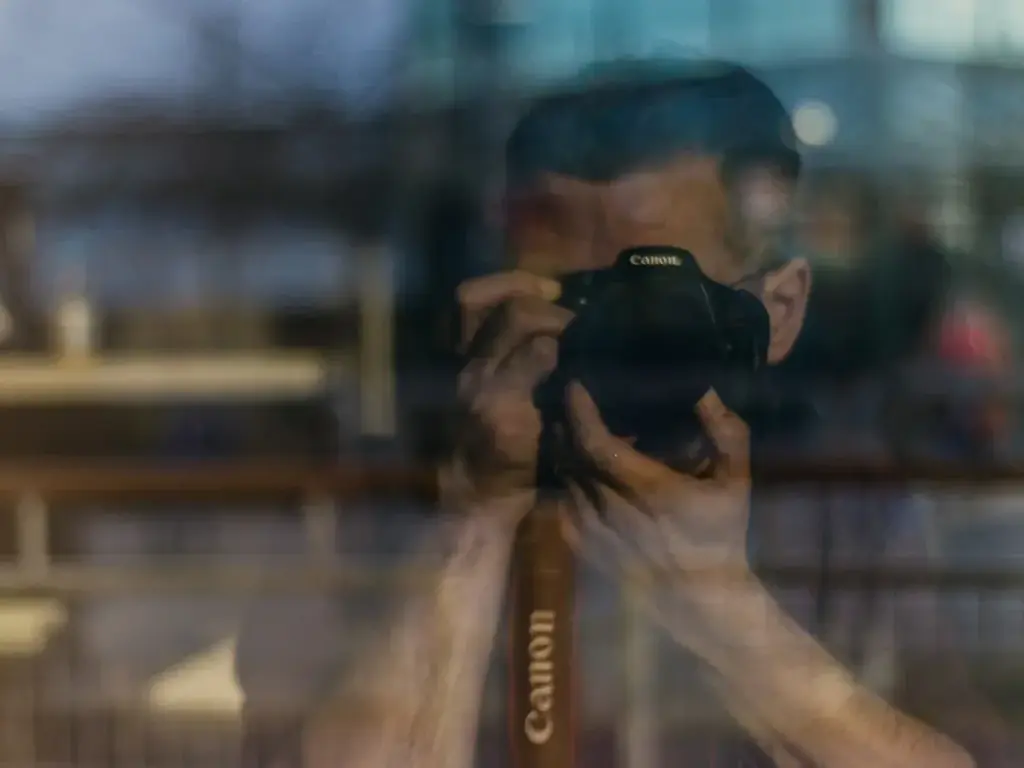
Shooting through glass works best when you control the light on your side of the window. Press the lens or a rubber hood against the pane, shade the camera with dark clothing or a cloth, keep the view mostly square on, and turn off lamps behind you so the reflections have nothing bright to show.
Why It Matters
Windows, aquarium walls, car glass, shop fronts and zoo enclosures all put a pane between you and the picture. Left alone, the glass acts as a weak mirror that shows you, your camera and everything bright behind you on top of the scene.
Because the fix is mostly about blocking light, it costs almost nothing. A few habits and one inexpensive accessory solve the great majority of problems, and they work with a phone as well as with a large camera.
Beginner Shooting Through Glass: The Basic Method
Glass reflects roughly four percent of light at each surface when you look straight at it. That sounds small, but a dim scene behind the window and a bright room behind you can make the reflection stronger than the subject. The trick is to make the side of the glass nearest you darker than the scene beyond it.
The Quick Method
- Move the lens as close to the glass as you can, even touching a rubber lens hood to it. This blocks the light that would otherwise reflect.
- Wear dark clothing, or drape a dark jacket, towel or cloth around the lens and your head like a tent.
- Turn off lamps, screens and torches behind you, and step away from bright walls.
- Switch to manual focus or place a single focus point on the subject so the autofocus system does not lock on to dirt on the pane.
- Take a test frame and check the corners for leftover reflections before you commit.
What Works For Each Situation
| Situation | Best Fix |
|---|---|
| Shop window by day | Rubber hood against the glass and a shaded body |
| Zoo or aquarium | Lens touching the pane, flash turned off |
| Airplane window | Lens close to the plastic and a dark jacket as a hood |
| Car window | Lower the glass if safe, or press the lens against it |
| Home window at night | Turn off indoor lights and shade the lens |
Shoot At A Small Angle
If you stand directly in front of the glass, the reflection of your camera and face lands right in the middle of the picture. Turning a little to the side, roughly 10 to 30 degrees, moves that reflection away from the lens axis. Do not go too far. At steep angles, glass reflects much more light, and the picture can wash out completely.
Common Mistakes
- Using flash, which bounces straight back off the pane and leaves a white blob.
- Standing a few feet away, where the lens sees the whole room reflected.
- Focusing on dust or a smudge instead of on the subject beyond.
- Wearing a bright shirt that appears faintly in the glass.
A cheap flexible rubber lens hood or a collapsible rubber ring is a handy tool. It seals against the pane, blocks side light and keeps the lens from touching the glass. Pick one that fits the filter thread, or simply hold a dark cloth around a bare lens.
Handy for this: ND And Polarizing Filters — control light and glare. (affiliate link)
Advanced Polarizers, Wide Apertures And Glass Tint
Using A Circular Polarizer
A circular polarizer cuts reflected light because reflections from glass are partly polarized. The effect is strongest when you view the glass at about 55 to 60 degrees from the surface normal, which is the angle at which a window reflection is almost fully polarized. At that angle you rotate the filter until the reflection fades. Looking straight on, the filter does little, which is why the pane-contact method matters more when you cannot angle the camera. A polarizer also costs one to two stops of light, so check that shutter speed stays safe. See lens hood for how a hood and filter work together.
Blurring Away Smudges
Dirt on the near side of the glass is very close to the lens. If you use a wide aperture, such as f/2.8 or wider, and move the lens to within a few centimeters of the pane, that dirt is so far out of focus that it vanishes, much as a speck on the front of a lens disappears. Stopping down brings the marks back into sharp focus. For subjects behind the glass, such as animals in an enclosure, shoot with a long focal length at the widest aperture and focus on the animal, not on the glass. Adding depth between you and the subject also helps blur wire mesh and scratches.
Fixing Tint And Color Casts
Car windows, bus glass and some museum glass tint the light. Shoot raw so you can correct white balance later, and use a gray card or a custom white balance reading through the glass where possible. Double-glazed windows can create two faint reflections, one from each pane, so shade the lens and rotate your position until both disappear. Laminated safety glass can produce a faint double image of high-contrast edges, which no filter will fix.
Night And Dark Interiors
At night, a bright room behind you turns a window into a mirror. Turn the lights off or move the camera so you only see the dark. When you must keep lights on, shade the camera with a dark board or flag. Look at the viewfinder rather than the screen because the screen may hide faint ghosts. If you light the subject with a flash, place it off to one side so the reflected flash bounces away from the lens, as shown in off-camera flash.
Handling Flare And Sun
When the sun hits the pane, the glass can scatter light and cause veiling haze. Shield the lens with a hood and, if needed, your hand, then check lens flare for ways to control it. Clean the glass if you can, since wiping the inside or the outside of the pane removes the grease that causes haze.
Cleaning Up In Software
A small leftover reflection can be reduced with a graduated mask, a dehaze adjustment or by lowering highlights in that area. Do not rely on software for heavy reflections, because the lost detail cannot be recovered. A better habit is to take several frames with slightly different positions and choose the cleanest.
Try It
- Photograph a shop window from 2 meters away, then again with the lens touching the glass and a jacket draped around it, and compare the reflections.
- Shoot the same window from straight on and from 20 degrees to the side.
- Put a circular polarizer on the lens and rotate it while viewing the window at about 55 degrees.
- Take a close shot at the widest aperture and notice how smudges blur out.
Common Questions
Does a polarizing filter remove all window reflections?
No. It removes the polarized part of a reflection, mainly when you view the glass at a slanted angle. Straight on, a polarizer does little, so block light with a hood and dark cloth instead.
Should I use flash when shooting through glass?
Usually not. Flash bounces off the pane and returns to the lens as a bright patch. If you must light the subject, place the flash well to one side or hold it against the glass at an angle.
How do I stop autofocus locking on to the glass?
Use manual focus, or use a single small focus point on the subject beyond the pane. Pressing the lens close to the glass and using a wide aperture also helps.
Why do my photos through car windows look tinted?
Many car and bus windows have a color tint or a coating. Shoot raw, set a custom white balance if you can and correct the cast in editing.
Related Lessons
- Lens Hood for how hoods block stray light.
- Lens Flare to control haze from sun on glass.
- Off-Camera Flash for lighting a subject without bouncing flash back.
- Window Light Photography for working with light from windows.
Gear That Helps With This
Hand-picked kit that makes this lesson easier to put into practice.
Some links are affiliate links: if you buy through them we may earn a small commission at no extra cost to you. How this works.