
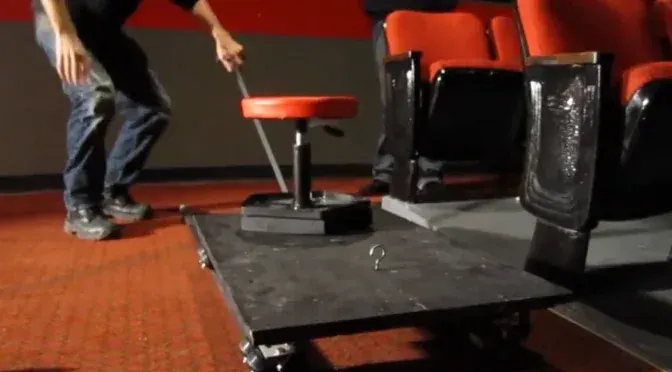
Skateboard dolly shots use a skateboard or longboard as a low, rolling camera support. Mount the camera securely over the trucks, roll on smooth concrete at walking speed, and push or pull with a steady hand. Wide lenses hide small bumps, and a heavy, low setup keeps the move smooth.
Why It Matters
A real dolly and track cost hundreds or thousands of dollars. A skateboard costs very little, rolls on pavement and can create smooth tracking moves, low angles and push-ins that make ordinary footage look planned and professional.
The method has limits, because it relies on a smooth surface and careful speed. With a little practice, it gives you a reliable way to add movement to interviews, product videos, short films and sports clips.
Beginner Setting Up A Skateboard As A Dolly
You can start with a board you already own. Choose a flat, smooth surface, mount the camera low and move slowly. Most poor results come from rushing the push.
What You Need
- A skateboard or longboard with clean bearings and wheels that spin freely.
- A small tripod head, ball head or clamp that attaches to the board with a 1/4 inch screw.
- A camera plate or quick release so the camera cannot slip.
- A strap, safety cord or tape as a backup in case the screw loosens.
- A smooth, level path such as an empty parking lot or gym floor.
Basic Method
- Place the board on the ground and attach the head near the middle, directly over or between the trucks.
- Mount the camera and tighten every screw, then give it a firm shake to check that nothing moves.
- Frame the shot and lock the focus and exposure before you roll.
- Crouch beside the board and push it with one hand in a straight line, or pull it with a smooth cord.
- Move at a slow, steady pace and let the board roll to a stop instead of braking suddenly.
Three Common Ways To Use It
| Method | How It Works | Best For |
|---|---|---|
| Rolling dolly | Camera on a board, pushed or pulled along the ground | Tracking moves, push-ins and pulls |
| Slider on a board | Camera on a smooth board that slides across a table or floor | Short, controlled moves for products and details |
| Follow rig | A friend carries the board beside the subject | Walking and talking shots |
Common Mistakes
- Pushing too fast, which exaggerates every crack and bump.
- Mounting the camera high on a tall head, which makes the board wobble.
- Not locking down the camera, so it slides or tilts during the shot.
- Riding the board with the camera on it. Use it as a dolly only.
Practice a move several times, because the first few takes are usually uneven. Mark your start and end points with tape so that every take looks the same.
Handy for this: Carbon Fiber Tripod — sharp at slow shutter speeds. (affiliate link)
Advanced Surface, Balance, Speed And Lens Choice
Choosing The Surface
The surface sets the quality of the move. Smooth concrete, polished floors and asphalt in good condition work best. Sidewalks with expansion joints, gravel, tile grout lines and rough asphalt send vibration straight into the camera. Large soft wheels, such as 65 to 75 mm wheels with a durometer around 78A, absorb small bumps better than hard small skate wheels. If the ground is poor, lay a sheet of plywood or a long plastic board along the path as a track. A level path also prevents the board from drifting sideways. Check the route by walking it first and removing small stones.
Weight And Balance
Keep the camera low and centered. A tall rig acts like a pendulum, so every wobble in the wheels is magnified at the lens. Place the head directly over the trucks, add a sandbag or small weight near the base, and keep cables out of the wheels. A heavier setup is steadier, but is also harder to start and stop smoothly. If the rig tilts forward or back, shift the camera until the board rolls straight with a gentle push. Use a short strap from the camera to the board, because a falling camera hurts more than a wobbling one.
Controlling Speed
Slow moves look more professional. Aim for walking speed or slower, about 1 to 2 feet per second for a close push-in. Start and stop gently, since a sudden start or stop shows as a jerk in the frame. Pulling the board with a smooth cord from the front, or having a partner push it slowly, helps keep speed even. Shoot at the normal frame rate, such as 24 frames per second with a shutter speed near double the frame rate, as described in the 180 degree shutter rule, so that the motion blur looks natural. Rolling shutter can bend vertical lines during fast moves, so keep speed low. See rolling shutter.
Pairing With Fixed Lenses
A wide prime lens is the best match for a rolling dolly. A 24mm, 28mm or 35mm lens on a full frame camera makes small bumps less noticeable than a long lens, which magnifies every shake. A fixed focal length also does not change in size as you roll, and it avoids the lens creep and focus shifts that can appear with zooms. Focus on the subject before you start, or use continuous autofocus with face detection if the lens can track smoothly. For more on lens choices, see wide angle lenses. If your camera has sensor shift or lens stabilization, turn it on, as explained in image stabilization.
Fixing Small Bumps In Editing
Even a good run has tiny vibrations. A stabilizer in your editor, such as Warp Stabilizer, can smooth them, though it crops the image slightly and can create wobble if used too strongly. Start with low smoothness values. If the shot is for a gimbal style move you can compare it with gimbal shots to see which method suits each scene.
Try It
- Find a smooth parking lot or hallway and walk the path to remove small stones.
- Mount your camera low and centered on the board and check that all screws are tight.
- Push the board at walking speed three times and compare the smoothness of each take.
- Repeat with a wide lens and a longer lens, then compare how much each one shows bumps.
Common Questions
Can I use a skateboard as a camera dolly?
Yes. Mount the camera low over the trucks, roll on smooth concrete and move at walking speed. It works well for low tracking shots and push-ins.
What wheels are best for skateboard dolly shots?
Larger, softer wheels around 65 to 75 mm with a durometer near 78A roll over small bumps better than small hard wheels. Keep the bearings clean for an even roll.
What lens should I use on a skateboard dolly?
A wide prime, such as 24mm to 35mm on full frame, hides vibration best. Long lenses magnify every bump and are harder to keep steady.
How do I keep skateboard dolly footage smooth?
Pick a smooth surface, keep the setup low and balanced, and push slowly with steady hands. A light stabilizer pass in your editor can remove small leftover vibration.
Related Lessons
- Gimbal Shots for another way to create smooth moving camera footage.
- No Tripod Stabilizing for steadying a camera with simple household items.
- Wide Angle Lenses for the lens choice that hides vibration best.
- 180 Degree Shutter Rule for setting a shutter speed that makes natural motion blur.
- Warp Stabilizer for smoothing leftover shake after the shot.
Gear That Helps With This
Hand-picked kit that makes this lesson easier to put into practice.
Some links are affiliate links: if you buy through them we may earn a small commission at no extra cost to you. How this works.